Surplus Circuit Breakers: Which Ones Have Resale Value and Which Are Scrap
Learn which breaker families, frames, amp ratings, trip units, interrupting ratings, drawout cradles, accessories, conditions, and quantities affect resale.
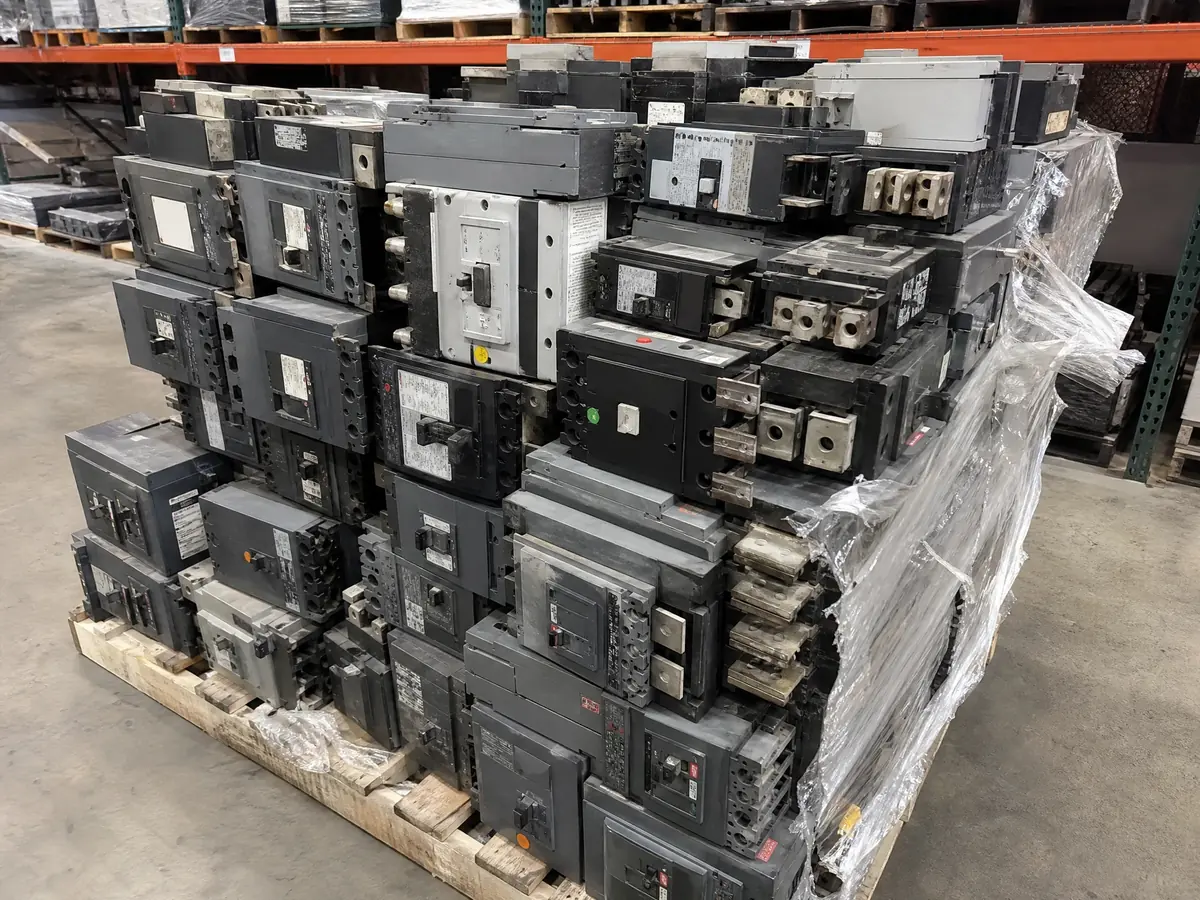
When a facility upgrade, demolition project, or data center decommissioning leaves you with a stockpile of surplus circuit breakers, determining their true market value is often the most challenging part of the asset recovery process. Circuit breakers are complex, highly engineered devices that protect critical electrical infrastructure, and their resale value is influenced by a multitude of factors ranging from the specific frame size and amperage rating to the installed trip unit and included accessories. While some obsolete or heavily damaged units may only be worth their weight in scrap metal, many modern or highly sought-after legacy breakers can command significant resale value, especially if they are in good working condition or are new in the original packaging. For contractors, plant managers, and asset recovery teams, accurately sorting the valuable inventory from the scrap is essential to maximizing the return on investment from surplus electrical equipment.
Understanding what makes a surplus circuit breaker valuable requires a detailed look at its technical specifications and physical condition. The secondary market for industrial electrical equipment is driven by the immediate needs of facilities looking to replace failed components, expand existing systems, or maintain older switchgear that is no longer supported by the original manufacturer. Consequently, the demand for specific breaker families, interrupting ratings, and drawout configurations can fluctuate based on broader industry trends. By identifying the key nameplate details and assessing the overall condition of your surplus breakers, you can make informed decisions about whether to sell them to a specialized buyer or send them to the scrap yard. Industrial Electrical Surplus buys transformers, switchgear, circuit breakers, panels, MCCs, and cable nationwide; sellers send photos and nameplate details; the company arranges freight/rigging; payment is issued before pickup; phone is (951) 903-9804.
How Do Frame Size and Amperage Rating Affect Value?
The fundamental building blocks of a circuit breaker's identity—and its value—are its frame size and continuous amperage rating. The frame size dictates the physical dimensions and the maximum current capacity the breaker is designed to handle, while the specific amperage rating indicates the actual continuous current it is calibrated to carry. In the secondary market, larger frame sizes and higher amperage ratings generally correlate with higher intrinsic value, simply because these units are more expensive to manufacture and purchase new. For example, a 4000-amp main tie breaker will typically hold significantly more resale value than a standard 100-amp molded case circuit breaker used for branch circuit protection.
However, value is not solely determined by size. The demand for specific amperage ratings within a given frame size can vary widely. Common ratings that are frequently used in standard industrial applications may sell more quickly, while highly specialized or unusual ratings might take longer to find a buyer. When evaluating your surplus inventory, it is crucial to document the exact frame type and amperage rating from the nameplate, as this information is the first thing a buyer will look for when assessing the potential worth of the equipment.
Why Are Trip Units and Interrupting Ratings Critical?
Beyond the basic physical size and continuous current capacity, the intelligence and performance capabilities of a circuit breaker heavily influence its desirability. The trip unit is the brain of the breaker, responsible for sensing overcurrent conditions and initiating the tripping mechanism. Modern electronic and solid-state trip units, which offer adjustable settings for long-time, short-time, instantaneous, and ground fault protection (LSIG), are highly sought after because they allow for precise coordination within complex electrical systems. Breakers equipped with advanced, functioning trip units typically command a premium over older thermal-magnetic models.
Equally important is the interrupting rating, which specifies the maximum fault current the breaker can safely interrupt without sustaining catastrophic damage. In industrial environments where available fault currents can be extremely high, breakers with high interrupting ratings are essential for safety and compliance. A surplus breaker with a standard interrupting rating might be suitable for many applications, but a high-interrupting-capacity version of the same breaker will generally have a broader market appeal and higher resale value. Always ensure that the interrupting rating is clearly legible on the nameplate when preparing your surplus equipment for sale.
What Is the Difference Between Drawout and Fixed-Mount Configurations?
The physical mounting configuration of a circuit breaker plays a significant role in its application and, consequently, its value on the secondary market. Drawout circuit breakers are designed to be easily inserted into and removed from a switchgear assembly, often utilizing a racking mechanism and a dedicated cradle or cassette. This design allows for rapid replacement during maintenance or in the event of a failure, minimizing downtime for critical operations. Because of their complexity and the convenience they offer, drawout breakers—especially when sold complete with their associated cradles—are generally more valuable than fixed-mount breakers of the same electrical specifications.
Fixed-mount breakers, while simpler and often less expensive, are permanently bolted into the panel or switchboard. Replacing a fixed-mount breaker requires completely de-energizing the equipment and performing more extensive mechanical work. While there is certainly a robust market for fixed-mount breakers, particularly in smaller amperage ranges and standard distribution panels, the premium prices are typically reserved for the large, drawout air circuit breakers and insulated case breakers used in main switchgear lineups.
When Does Obsolescence Increase Value Versus Rendering Equipment Scrap?
The concept of obsolescence in the electrical equipment market is nuanced. In many technology sectors, older equipment is worthless, but in the industrial electrical world, obsolescence can sometimes drive up value. Many manufacturing plants, utilities, and commercial buildings operate on electrical infrastructure that was installed decades ago. When a critical breaker in one of these aging systems fails, the facility manager often prefers to find an exact, direct replacement rather than undergo the massive expense and downtime associated with retrofitting a modern breaker or replacing the entire switchgear lineup. Consequently, certain obsolete breaker families that are no longer manufactured but still widely installed can be highly valuable.
Conversely, obsolescence becomes a liability when the equipment is so old or obscure that there is little remaining installed base or demand for replacements. In these cases, or when the breaker family has been superseded and few compatible systems remain in service, commodity recovery may be the practical route. A specialized buyer can check whether an older frame still has replacement demand before the seller makes an irreversible scrap decision.
How Should Condition and Packaging Be Evaluated?
The physical and operational condition of a surplus circuit breaker is an immediate determinant of resale interest. Breakers described as New In Box (NIB) or New Surplus (NS) should be documented carefully, including packaging, seals, labels, and any signs of storage damage. Unused condition can improve buyer confidence, but catalog number, frame, trip unit, interrupting rating, and compatibility still control demand. Clean used breakers removed from protected indoor environments may also be marketable when their identity and condition are clear.
Breakers that show severe environmental exposure, heavy rust, water damage, cracked casings, broken mechanisms, or evidence of a major electrical fault require a cautious assessment and may have only parts or commodity value. Sellers should not represent condition beyond what records and inspection support. Clear photos of the nameplate, housing, terminals, drawout stabs or contacts when safely visible, trip unit, accessories, and packaging allow a buyer to identify what additional inspection or testing may be needed.
Ready to sell? Get your offer today.
Send photos and nameplate details — we respond with a firm offer, typically within 24 hours. Freight and rigging arranged nationwide, payment before pickup.
Frequently Asked Questions
- What information is needed to get an offer on surplus circuit breakers?
- To evaluate surplus circuit breakers, buyers need clear photos of the equipment, specifically focusing on the manufacturer's nameplate. The nameplate provides essential details such as the catalog number, frame size, amperage rating, trip unit type, and interrupting capacity. Additionally, noting whether the breakers are new in the box or used, and providing a general quantity, will help expedite the valuation process.
- Does Industrial Electrical Surplus buy both new and used circuit breakers?
- Yes, Industrial Electrical Surplus purchases a wide variety of circuit breakers nationwide, including new in box, new surplus, and used units. While new equipment in original packaging generally commands the highest value, there is a strong market for well-maintained used breakers, particularly those from common industrial families or highly sought-after legacy systems.
- How is the shipping handled for heavy or bulky circuit breakers?
- Logistics for heavy electrical equipment can be challenging, but Industrial Electrical Surplus handles all the freight arrangements. Whether you have a single pallet of molded case breakers or multiple truckloads of large drawout air circuit breakers, the company will coordinate the transportation and rigging required to move the equipment safely from your facility.
- When is payment issued for surplus electrical equipment?
- A key advantage of working with Industrial Electrical Surplus is the secure payment process. Once an agreement is reached and the equipment is ready for transport, payment is issued in full before the circuit breakers ever leave your site. You can contact them at (951) 903-9804 to start the process.